
AMD and HPE introduce the Helios rack-scale AI architecture featuring the new Venice CPU, MI455X GPU, and hardware that will also power the upcoming Herder supercomputer. Explore how this open platform aims to reshape large-scale AI infrastructure by 2026.
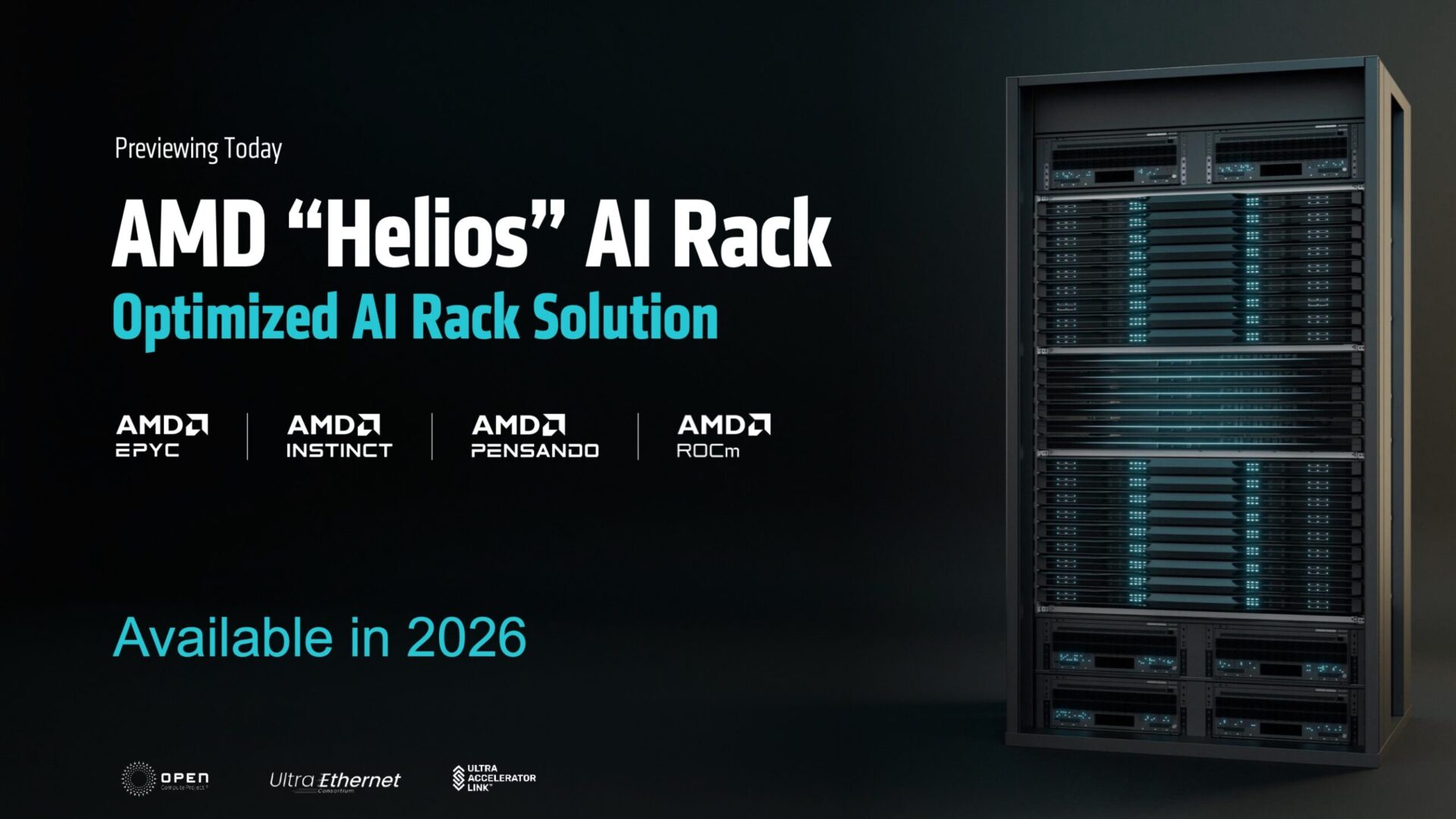
AMD and Hewlett Packard Enterprise (HPE) have taken another significant step in their long-running collaboration by unveiling a new open AI infrastructure known as Helios. At its core, Helios is designed as a rack-scale platform that tries to make handling large and complex AI workloads a bit more streamlined for companies and research organizations. HPE will be among the first manufacturers to adopt this design, blending AMD’s newest processors, accelerators, and networking technologies with HPE’s system engineering. Both companies seem to be aiming for a solution that feels flexible enough for cloud providers and powerful enough for enterprises preparing for the AI demands expected around 2026.
Key Takeaways
- AMD and HPE are building Helios, an open architecture meant for large-scale AI workloads.
- The platform brings together the AMD Instinct MI455X GPU and the EPYC Venice CPU.
- HPE plans to integrate Juniper Networking switches using Broadcom technology for high-speed data movement.
- A new supercomputer named Herder will be constructed in Germany using this architecture.
- Helios is expected to roll out globally in 2026 with a focus on scale, efficiency, and flexibility.
The Helios Architecture Details
Helios is built to manage the increasingly heavy computational needs of modern AI tasks, and perhaps even some that have not fully emerged yet. At the center of the architecture are the upcoming AMD EPYC Venice processors paired with the AMD Instinct MI455X GPUs. These components operate together in a single rack system that tries to give users a straightforward way to achieve very high performance without stitching together multiple incompatible pieces of hardware.
Networking plays a much larger role here than it might seem at first glance. Helios incorporates AMD Pensando Vulcano network interface cards connected through the ROCm open software stack, which many developers already rely on for running AI and HPC workloads. When configured with FP4 data types, a full Helios rack can reach up to 2.9 exaFLOPS of performance. It is the kind of number that almost feels abstract, but it becomes more understandable when considering how large language models and other AI systems continue to grow.
HPE is extending the design by contributing its own networking strengths. The system includes a purpose-built Ethernet switch developed with Broadcom, using the Ultra Accelerator Link over Ethernet standard. This detail matters because AI infrastructure tends to be as limited by bandwidth and latency as by raw compute power. Faster movement of data between GPUs, CPUs, and storage helps keep the entire system running smoothly.
Herder Supercomputer for European Research
Another major outcome of this partnership is a supercomputer called Herder, which will support scientific work at the High-Performance Computing Center Stuttgart (HLRS) in Germany. This project feels like a natural example of how the Helios architecture might be adapted for environments that handle both traditional simulations and more modern machine learning research.
Herder will be built on the HPE Cray Supercomputing GX5000 platform. It will use AMD Instinct MI430X GPUs alongside the next-generation EPYC Venice CPUs. This combination should give researchers the performance they need for tasks ranging from industrial studies to scientific modeling.
Professor Dr. Michael Resch, the Director of HLRS, emphasized that this system aligns with the expectations of their research community. It supports long-established numerical simulation methods while also making room for the growing presence of AI and machine learning. Delivery is planned for the second half of 2027, with full operation expected by year’s end.
Focus on Open Standards
One consistent theme in this collaboration is the shared interest in open standards. Helios relies on the Open Compute Project Open Rack Wide specifications, which help organizations deploy equipment more quickly and customize layouts without being locked into proprietary designs. It is a practical approach that tends to appeal to cloud providers and large enterprises trying to scale their systems over time.
HPE CEO Antonio Neri pointed out that this approach offers cloud providers more flexibility as they expand their AI operations. Meanwhile, AMD CEO Dr. Lisa Su noted that aligning their technologies into a single platform helps drive both efficiency and performance for customers entering what she described as a rapidly evolving AI era.
Frequently Asked Questions
Q1: What is the AMD Helios architecture?
A1: Helios is an open, rack-scale platform created for AI infrastructure. It brings together AMD CPUs, GPUs, and networking hardware to support demanding AI workloads.
Q2: When will the Helios platform be available?
A2: HPE expects to offer the AMD Helios AI Rack-Scale Architecture starting in 2026 for customers worldwide.
Q3: What chips does the Herder supercomputer use?
A3: The Herder supercomputer will feature AMD Instinct MI430X GPUs paired with next-generation AMD EPYC Venice CPUs.
Q4: How does Helios handle networking?
A4: Helios uses an HPE Juniper Networking switch developed with Broadcom. It supports the Ultra Accelerator Link over Ethernet standard to provide fast data movement across the system.
Q5: Who is the target audience for this new technology?
A5: The platform is intended for cloud service providers, large enterprises, and research institutions that need to run massive AI models or complex scientific simulations.