
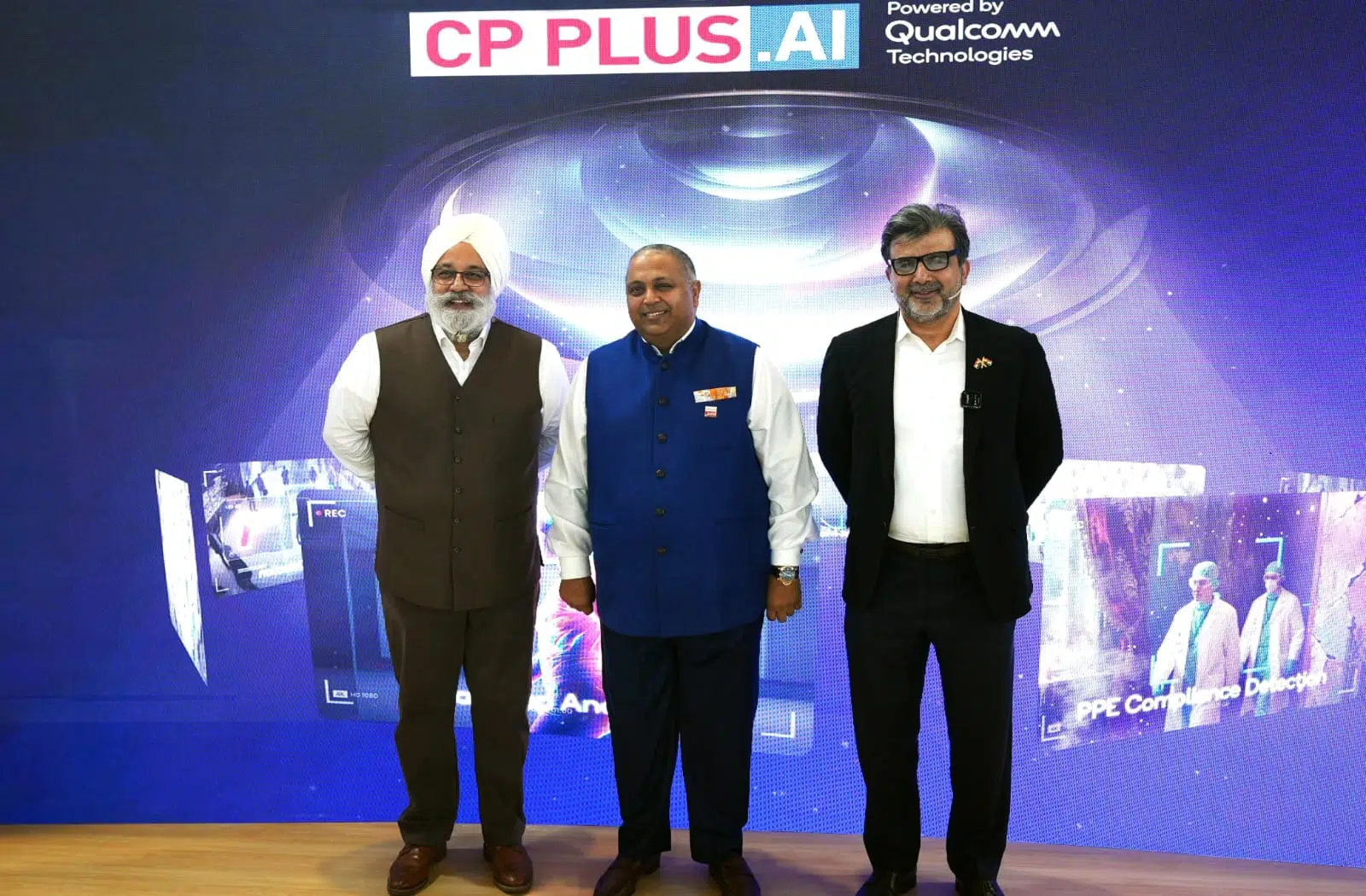
It is interesting to see how quickly the video security landscape is evolving, and the recent announcement from CP PLUS and Qualcomm Technologies on December 11, 2025 seems to add another strong push in that direction. The two companies are combining their strengths, one being India’s largest video security brand and the other a global name in processors and AI, to build a new generation of video security tools that do much more than simply record footage. These solutions are expected to reach the market in the first quarter of 2026, which is not too far away.
Key Takeaways
- Partnership: CP PLUS and Qualcomm Technologies are working together to create smarter and more responsive video security systems.
- Technology: The solutions integrate Qualcomm Dragonwing processors along with the Qualcomm Insight Platform.
- Edge AI: Cameras can process video directly on the device, which enhances privacy and improves the speed of alerts.
- Target Audience: Ideal for public safety, industrial environments, offices, and retail spaces in India.
- Availability: Commercial rollout is expected in early 2026.
Moving Beyond Passive Recording
What stands out in this partnership is the attempt to move the industry past the older idea of cameras that simply capture footage for later review. Most security systems today still operate that way. Here, the aim is to introduce intelligent systems that interpret what they see as events unfold.
The core technology comes from Qualcomm Dragonwing processors paired with the Qualcomm Insight Platform. Together, they enable what is often called edge computing, and the idea is fairly simple. Instead of sending every frame to a remote server for analysis, the camera itself takes on a good part of that workload. Because the processing stays local, alerts can be generated faster and the need to move sensitive data across networks is reduced. That air gapped architecture perhaps provides a sense of security, especially for organisations that cannot afford any data leakage.
This shift from passive recording to real time awareness might be the most significant change for users who rely heavily on immediate responses rather than post incident investigations.
Real World Applications for India
These solutions have been shaped with Indian conditions in mind, at least that is what both companies emphasise. And when you think about the variety of environments across India, ranging from crowded public spaces to high risk industrial zones, the breadth of applications becomes clearer.
- Public Safety: The system can estimate crowd density, identify blocked pathways, and potentially help authorities manage large events better.
- Industrial Safety: In factories, the cameras can detect whether workers are wearing PPE such as helmets or reflective vests, which might reduce manual supervision.
- Retail Insights: Store owners can use analytics to understand footfall patterns and customer movement, which could help refine store layouts.
- Smart Search: Instead of scanning hours of footage, users can search for events or objects using natural language. This is enabled by a built in Generative AI Assistant, which feels like a practical improvement rather than a novelty.
These tools are meant to function reliably in environments that may not always have perfect connectivity or consistent infrastructure, which is why edge AI plays such an important role.
Made for Indian Needs
The phrase built for India is highlighted a few times in the announcement, and in a way, it reflects how the companies are positioning the product. Aditya Khemka, Managing Director of CP PLUS, mentions that the collaboration aims to offer scalable and dependable security systems that match the pace of the country’s rapidly changing requirements. With CP PLUS’s distribution network and Qualcomm’s technological depth, the expectation is that high end video intelligence will become more widely accessible.
Abhishek Singh from the India AI Mission adds another perspective, noting that this aligns with India’s broader AI ambitions. The idea is not just to observe what is happening but to understand it and act quickly when needed. That shift from visibility to actionable intelligence might become increasingly important as security challenges evolve.
Frequently Asked Questions (FAQs)
Q1: What is the main benefit of the CP PLUS and Qualcomm partnership?
A1: The partnership aims to create security cameras that use AI to analyze video in real time. This helps users detect accidents, safety violations, or security threats instantly instead of just recording them.
Q2: When will these new AI security cameras be available in India?
A2: The companies expect to make these solutions commercially available in the first quarter of 2026.
Q3: What is Edge AI in video security?
A3: Edge AI means the camera or a local device processes the video data itself. It does not need to send all the footage to the cloud. This makes the system faster and keeps the data more secure.
Q4: Can these cameras be used for things other than security?
A4: Yes. Retailers can use them to analyze customer behavior, and factories can use them to ensure workers are following safety rules.
Q5: Will my data be safe with these new cameras?
A5: The solution uses an air gapped design, which means it can process video without connecting to external networks. This reduces the risk of data leaks.