

I think we can all agree that our charging drawers are a mess. We have one charger for the laptop, one for the phone, another for the tablet, and maybe an old slow one for our wireless earbuds. For years, I’ve been hunting for one charger that can handle everything. The problem is, they are usually expensive, or they miss one key feature. This brings me to the Tempt Elite 30W GaN charger. I’ve been using this adapter for the past three weeks, and for its asking price of ₹899, it makes some very big promises.
- Key Takeaways
- Unboxing and First Impressions
- Design and Build Quality
- Key Product Specifications
- The GaN Difference: Why It Matters
- The Magic of PD and PPS
- Real-World Charging Performance
- Heat Management and Safety
- The Price: Its Biggest Advantage
- A Few Small Criticisms
- Verdict: Who Should Buy the Tempt Elite 30W?
It claims to be a Gallium Nitride (GaN) charger, which means it should be small and cool. It also claims to support both Power Delivery (PD) and Programmable Power Supply (PPS). That last one, PPS, is the secret sauce for charging Samsung phones at their top speeds. As someone who switches between an iPhone and a Samsung device, this got my attention. But for ₹899, I was skeptical. I’ve tested it with my phones, my laptop, and my tablet. Here is my detailed review.
Key Takeaways
- At ₹899, this is one of the most affordable 30W GaN chargers available in India.
- It supports both PD (for iPhones, Pixels, laptops) and PPS (for Samsung Super Fast Charging).
- It successfully charged my MacBook Air M2 at the full 30W speed.
- The charger is extremely compact and lightweight, making it great for travel.
- The black glossy finish is a major fingerprint and smudge magnet.
- There is no charging cable included in the box, so you must supply your own.
Unboxing and First Impressions

The packaging is basic, which is fine for a product in this price range. Inside the small cardboard box, you get the charger itself and a small warranty card/user guide.
There is no charging cable. This is important to know. To get the 30W speeds this charger offers, you need a capable cable. This means a USB-C to USB-C cable rated for at least 3 Amps (or 60W) for Android phones and laptops, or a high-quality USB-C to Lightning cable for older iPhones. For the iPhone 15 series, a good USB-C to C cable works.
My first thought holding the adapter was about its size. It is tiny. It’s significantly smaller than the 30W charger that came with my MacBook Air and even a little smaller than the old 20W cube charger from Apple. This is the GaN technology at work.
Design and Build Quality
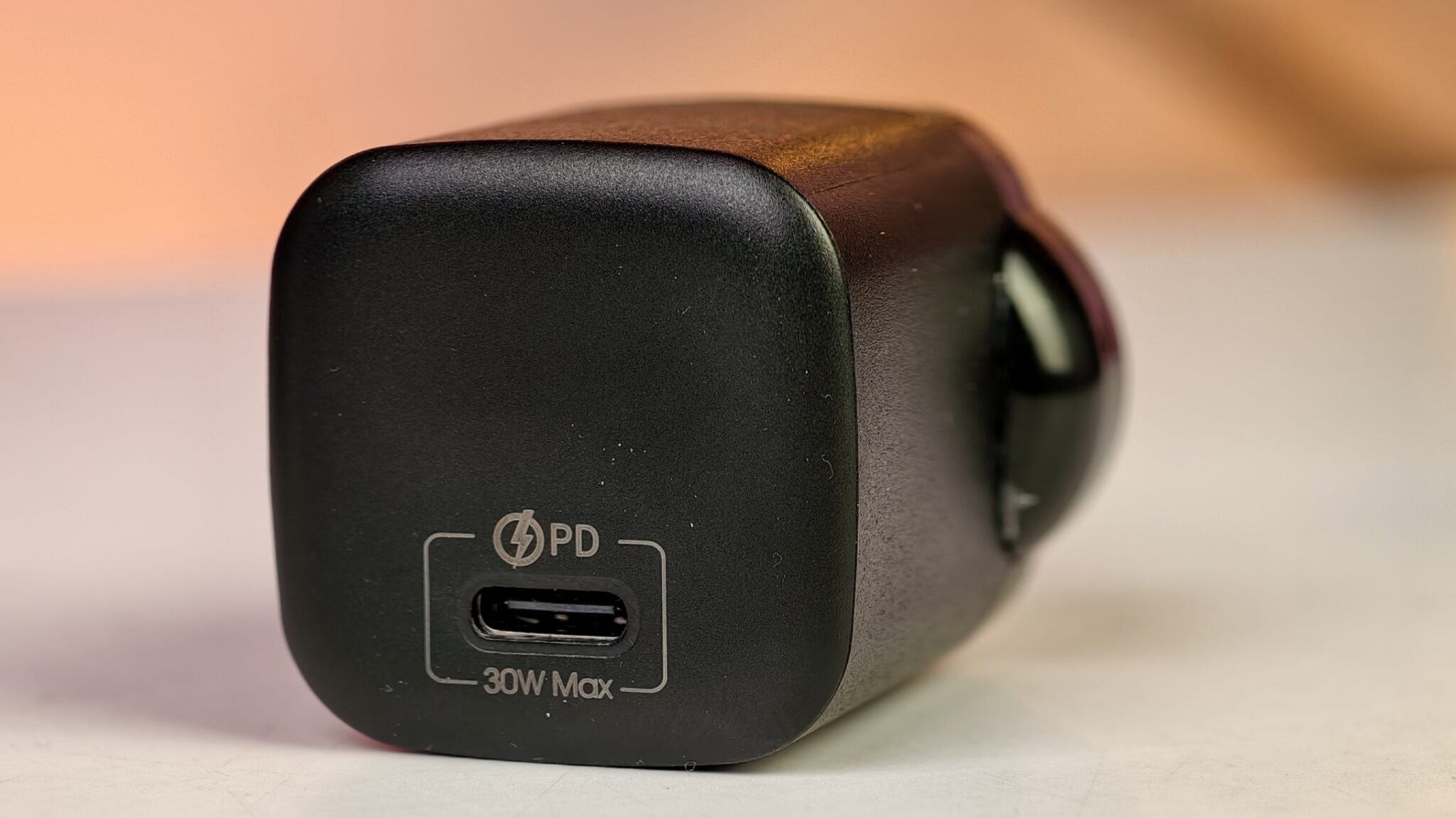
I have the black variant, and it’s made of a very glossy plastic. Fresh out of the box, it looked sleek and minimalist. Within five minutes of handling it, it was covered in fingerprints and smudges. If this bothers you, I would strongly suggest looking at the white variant.
The build itself feels solid. It doesn’t feel hollow or cheap, despite the low price. It has a reassuring weight for its small size. The prongs are fixed (they don’t fold in) and are standard Indian-size plugs (Type C / Type D compatible). They fit snugly into my power strips and wall sockets without any wobble.

On the front, there is just one port: a single USB-C. This is a modern choice. Most new gadgets use USB-C, so this is what you want. There’s a very subtle “Tempt” logo on the side and the regulatory information, including the BIS certification mark, printed on the bottom.
Its small size is its biggest design feature. I can throw this in my bag and barely notice it. It doesn’t block adjacent ports on a power strip, which is a problem I’ve had with many other bulky fast chargers.
Key Product Specifications
Before we get to the performance, here are the technical details as listed by the company:
- Product Name: Tempt Elite 30W Charger
- Technology: Gallium Nitride (GaN)
- Power Output: 30 Watts (Max)
- Port: 1 x USB-C
- Input: 100-240V ~ 50/60Hz 0.8A
- Output (PD/PPS): 5.0V/3.0A (15.0W), 9.0V/3.0A (27.0W), 12.0V/2.5A (30.0W), 15.0V/2.0A (30.0W), 20.0V/1.5A (30.0W)
- PPS Output: 3.3V-11.0V/3.0A
- Certifications: BIS Certified
- Compatibility (Claimed): iPhone, Samsung, OnePlus, iQOO, iPad, MacBook Air
- Features: Smart IC (Over-voltage, over-current, short-circuit, over-temperature protection)
- Color (Review Unit): Black
The GaN Difference: Why It Matters
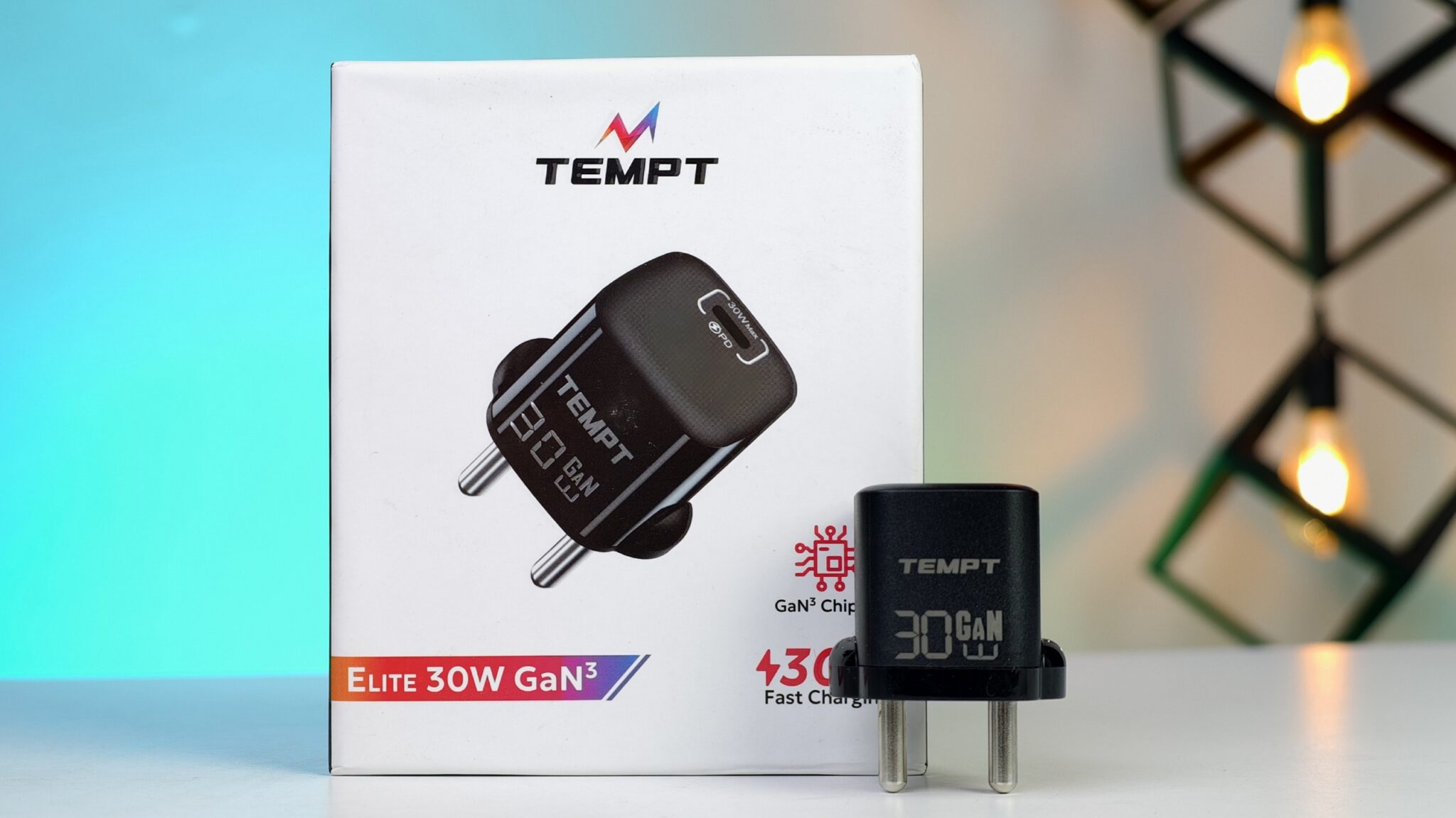
You see “GaN” advertised on many new chargers. What does it mean? For decades, chargers have been made using silicon. It’s a reliable material, but it’s not very efficient. It wastes a lot of energy as heat.
GaN stands for Gallium Nitride. It’s a newer material that can conduct electricity much better than silicon. Because it’s more efficient, it produces far less waste heat. This has two big benefits for us:
- Size: Since the components don’t need huge heat sinks, the charger can be made much, much smaller. As I mentioned, this 30W Tempt charger is about the size of an old 5W phone charger.
- Power: You can push more power through a GaN charger without it dangerously overheating.
This technology is what allows a single, tiny adapter to safely charge everything from your phone to your laptop.
The Magic of PD and PPS
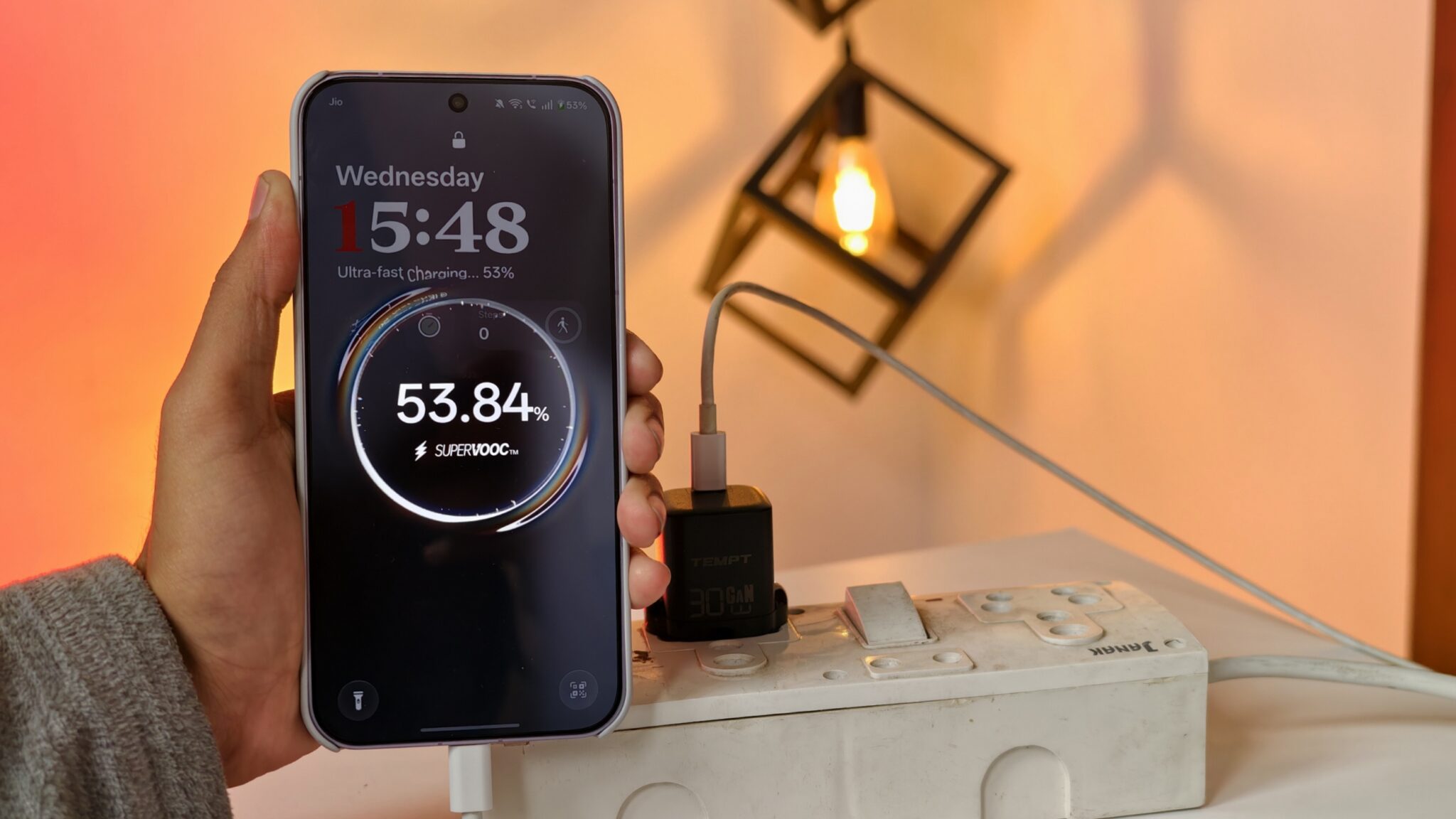
This is the most important part of the review. A 30W charger is useless if it can’t “talk” to your device properly. Modern fast charging relies on protocols, or languages, that let the charger and device negotiate the right amount of power.
- PD (Power Delivery): This is the universal standard. Apple’s iPhones (8 and newer), Google’s Pixel phones, and laptops like the MacBook Air and Dell XPS all use PD.
- PPS (Programmable Power Supply): This is a newer part of the PD standard. Samsung uses it for its “Super Fast Charging” (25W and 45W).
Here’s the problem: many cheap chargers say they are “PD” but don’t include PPS. If you plug one of those into a Samsung Galaxy S23 or S24, you will only get 15W or 18W charging, not the full 25W. The Tempt Elite 30W claims to have both. I put this to the test.
Real-World Charging Performance
I tested this charger across all my main devices for three weeks.
Test 1: Samsung Galaxy S23 Ultra (The PPS Test)
This was the test I cared most about. My S23 Ultra supports 25W Super Fast Charging. I plugged it in using a 5A USB-C cable when the phone was at 18% battery.
Instantly, the lock screen showed the cyan-colored charging circle and the message: “Super Fast Charging.” This was the confirmation I needed. The charger was correctly using the PPS protocol.
Here are the charging times I recorded:
- 18% to 50%: 22 minutes
- 18% to 100%: 59 minutes
These times are identical to what I get using Samsung’s official 25W charger. This is a huge win for Tempt. It means any Samsung user can buy this as a perfect, and much cheaper, replacement or travel adapter.
Test 2: iPhone 15 Pro (The PD Test)
Next, I tested my iPhone 15 Pro. The iPhone 15 series can take up to 27W of power. A 30W charger is ideal. I plugged it in at 20% battery.
The phone started charging rapidly.
- 20% to 50%: 24 minutes
- 20% to 80%: 48 minutes
Again, this is the maximum speed the iPhone 15 Pro is designed to charge at. It performs exactly like the much more expensive Apple 30W charger. It will also fast-charge older iPhones (like the iPhone 12, 13, 14) at their maximum 20W speeds.
Test 3: MacBook Air M2 (The 30W Laptop Test)
My MacBook Air M2 came with Apple’s 30W charger. I wanted to see if the Tempt Elite could be a true replacement.
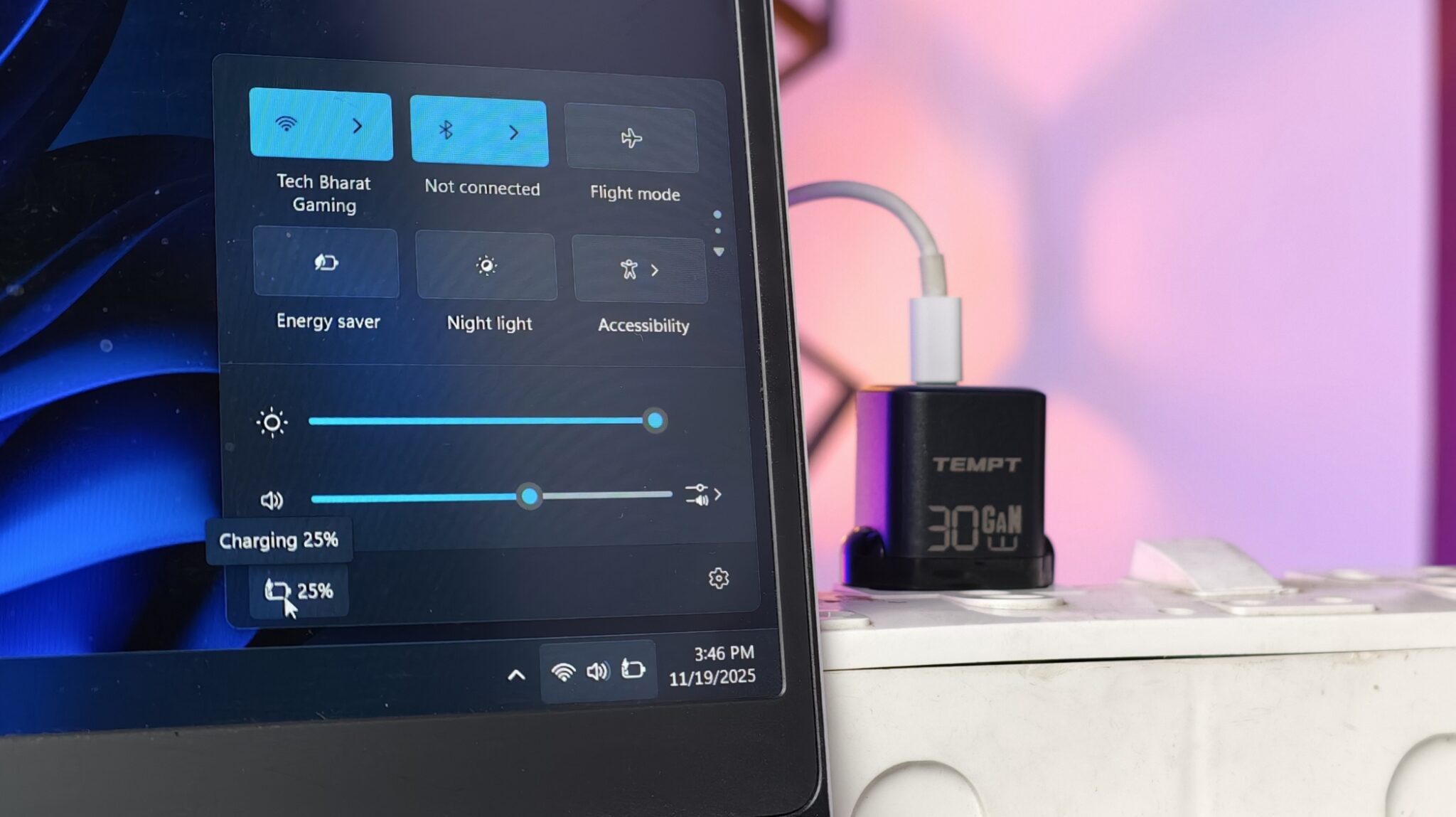
I used the laptop for my regular work (writing, 10-15 browser tabs, streaming music) and let the battery drain to 40%. I plugged in the Tempt charger. Not only did it stop the battery from draining, but it also actively charged it. It took the laptop from 40% back to 100% in about 2 hours, all while I was using it.
When I left the laptop to charge with the lid closed, it charged from 50% to 100% in about 90 minutes. This is fantastic. This tiny brick can genuinely power and charge an ultrabook.
Test 4: Other Devices
I also tried it with my iPad Air (5th Gen) and a pair of Nothing Ear (2) earbuds. It fast-charged the iPad perfectly. For the earbuds, the charger’s “Smart IC” correctly identified it as a low-power device and delivered a safe, slow charge.
Heat Management and Safety
My biggest fear with cheap chargers is safety. This is where the BIS certification is so important. It means the Bureau of Indian Standards has tested it for safety.
But how does it handle heat? Remember, GaN chargers run cooler, but “cooler” doesn’t mean “cold.” When pushing 30W, any charger will get warm.
To stress-test it, I charged my MacBook Air from 20% while streaming a 4K YouTube video. This draws the maximum 30W continuously. After about 45 minutes, I checked the charger. It was definitely warm to the touch, but it was not hot. I could comfortably hold it in my hand. It was no warmer than the official Apple charger, which is a great sign.
During normal phone charging (which ramps down power as the battery fills), it barely gets lukewarm. After three weeks of daily use, it has performed reliably without any overheating or strange behavior.
The Price: Its Biggest Advantage
Let’s talk about the price again: ₹899.
- Apple’s 30W USB-C Charger: ₹3,800
- Samsung’s 25W USB-C Charger: ₹1,299 (and it’s only 25W, with no 30W PD for a laptop)
- Anker 30W GaN Charger: Typically ₹1,800 – ₹2,500
The value proposition here is impossible to ignore. You are getting a modern GaN charger with both PD and PPS for a fraction of the cost of the big-name brands. This isn’t just cheap; it’s aggressively priced.
A Few Small Criticisms
No product is perfect, and I have a few complaints.
First, the glossy black finish. It just looks messy all the time. I find myself wiping it down, which is silly for a charger. I would recommend the white version to anyone who cares about aesthetics.
Second, the lack of a cable. I understand this is how they hit the ₹899 price, but a new user might buy this and get home, only to realize they can’t use it. You must factor in the cost of a good USB-C cable if you don’t already have one.
Finally, the marketing on the Amazon page is a bit… optimistic. It lists “iPhone 17/16” and “Galaxy S25/S24, Fold 5/6/7.” These products do not exist. This is just keyword stuffing and it looks unprofessional. I can confirm it works perfectly with current devices (iPhone 15, S24 series), which is what matters.
Verdict: Who Should Buy the Tempt Elite 30W?
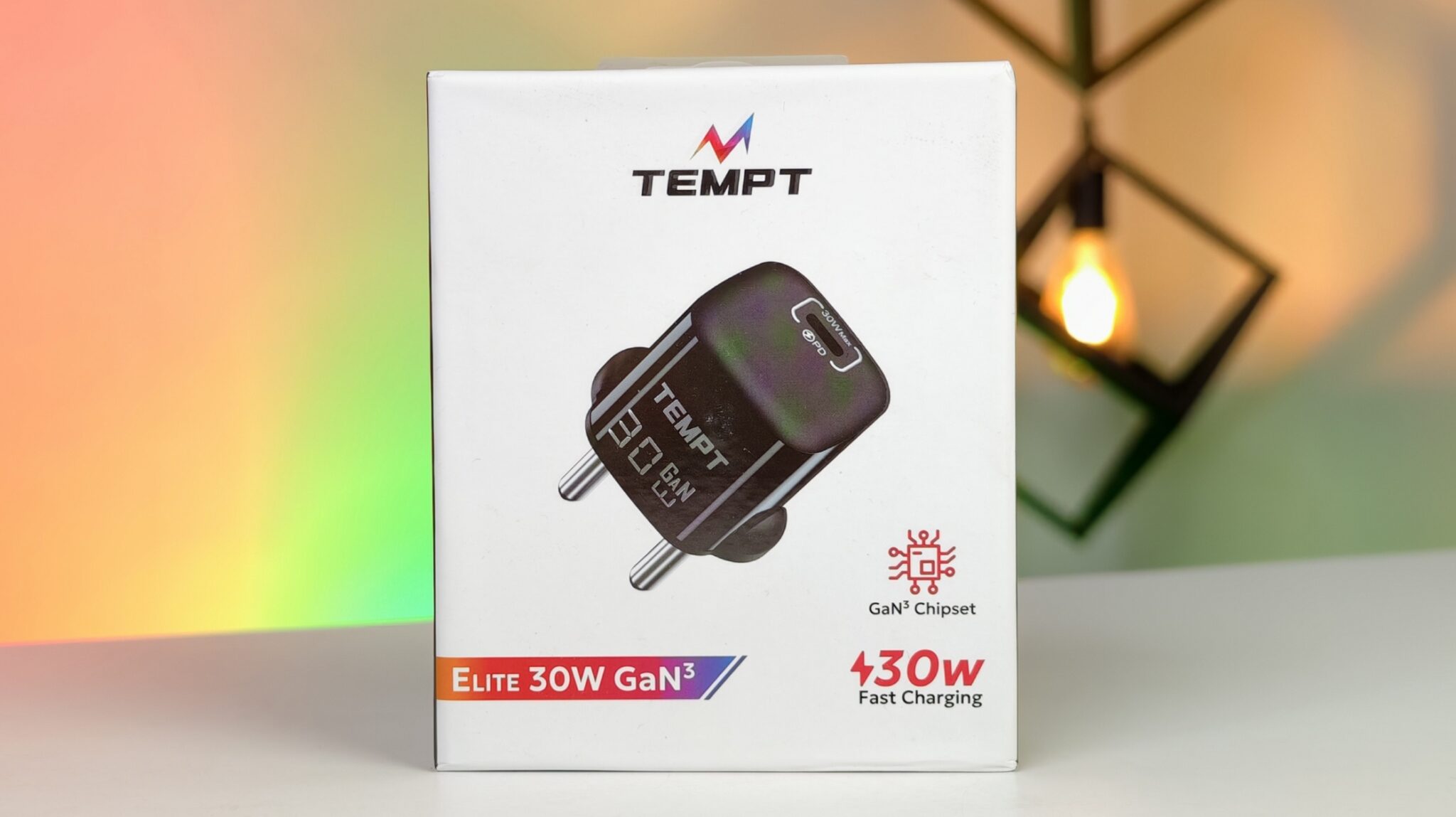
So, is the Tempt Elite 30W GaN charger worth your money?
My answer is a resounding yes. It is not just a “good for the price” product; it is a genuinely good product that also happens to be very inexpensive.
It has replaced three of my chargers. It’s the only one I put in my bag now. It can “Super Fast Charge” my Samsung phone, fast-charge my iPhone, and power my MacBook Air. The inclusion of PPS at this price point is the feature that seals the deal.
If you are a Samsung user, this is a must-buy. You get the same performance as the official charger for less money. If you are an iPhone 12-15 user, this is a perfect 20W-27W fast charger. If you have a MacBook Air, this is an excellent, tiny replacement for your 30W brick.
Frequently Asked Questions (FAQs)
Q1: Will this charger “Super Fast Charge” my Samsung phone?
A1: Yes. I tested it with a Galaxy S23 Ultra, and it correctly activated “Super Fast Charging” thanks to its PPS support. It should work with all Samsung phones that support 25W charging (like the S20, S21, S22, S23, S24 series, and recent A/M/F series phones).
Q2: Is this charger safe to use?
A2: It is BIS certified, which is the Indian standard for safety and quality. It also claims to have multiple protections (over-voltage, over-current, etc.). In my tests, it managed heat well and did not get dangerously hot.
Q3: Does it come with a USB-C cable?
A3: No, it does not. You will need to buy or use your own USB-C to USB-C cable or USB-C to Lightning cable.
Q4: Can this charger fast charge my iPhone?
A4: Yes. It provides up to 30W of Power Delivery (PD), which will charge any iPhone 8 or newer at its maximum possible speed.
Q5: Can I charge my MacBook Air with this?
A5: Yes. It delivers 30W, which is the same as the standard charger that comes with the MacBook Air (M1, M2, and M3 models). It will power and charge the laptop perfectly.
Q6: Will this charger damage my earbuds or other small devices?
A6: No. The charger has a “Smart IC” that negotiates power. It will recognize a low-power device like earbuds and deliver a safe, slow charge.
Q7: Is Tempt a good brand?
A7: Tempt appears to be a budget-focused Indian brand. While not as globally recognized as Anker or Belkin, this specific product (the Elite 30W) delivers exactly on its technical promises and has the required BIS safety certification.